Call us:864-276-1133 Mon-Fr:8:30am-5:00pm EST
St. Chrysanthe icon
Orthodox icon of Saint Chrysanthe.
Commemorated October 25th.
St. Chryse the Virgin- Martyr of Rome icon
Orthodox icon of Saint Chryse, Chrysoula the Virgin Martyr of Rome.
Commemorated January 30th.
Martyr Chryse the Virgin and 20 Others suffered in the year 269. Chryse was arrested and bravely confessed herself a Christian. As a result she was subjected to torture and then drowned in the sea. With St Chryse suffered the martyrs Ares, Felix, Maximus, Herculianus, Venerius, Stiracius, Mennas, Commodus, Hermes, Maurus, Eusebius, Rusticus, Monagrius, Amandinus, Olympius, Cyprus, Theodore the Tribune, Maximus the Presbyter, Archelaus the Deacon, and Cyriacus the Bishop.
When the Moslems saw that they could not weaken the resolve of the saint, they tormented her for three months, beating her with clubs. Later, they peeled strips of skin from her body so that the earth was reddened by her blood. Then they heated a skewer and passed it through her ears. Nearby was her spiritual Father, the hieromonk Timothy of Stavronikita Monastery on Mt. Athos. She sent word to him to pray that she would successfully complete the course of martyrdom.
It was he who recorded her martyrdom. Finally, the Moslems fell into a fury at having been conquered by a woman, so they tied her to a tree and cut her to pieces with their knives. Her pure soul was received by Christ, Who bestowed on her the double crowns of virginity and martyrdom. Certain Christians gathered her relics secretly and buried them with reverence. St Zlata suffered for Christ in the year 1795.
St. Cleopas the Apostle icon
Orthodox icon of Saint Cleopa, Kleopa, the Apostle.
Commemorated Octomber 30.
The Holy Apostle Cleopas, was one of the Seventy Disciples of our Lord Jesus Christ and he was the one with Apostle Luke that accompanied Him to the road to Emmaus, according to the Gospel of Saint Luke, 24: 13-35.
St. Cleopatra the Martyr icon
Orthodox icon of Saint Cleopatra. Contemporary icon.
Commemorated September 1st.
St. Climis icon
Orthodox icon of Saint Climis of Viotia.
Commemorated September 10.
St. Columba of Iona, the Enlightener of Scotland icon.
Orthodox icon of Saint Columba of Iona, the Enlightener of Scotland.
Commemorated June 9.
Our venerable and God-bearing Father Columba of Iona, Enlightener of Scotland (December 7, 521- June 9, 597) (also known as Columcille, meaning "Dove of the Church") was an Irish missionary who helped re-introduce Christianity to Scotland and the north of England. He was born to Fedhlimidh and Eithne of the Ui Neill clan in Gartan, near Lough Gartan, Donegal.
On his father's side he was great-great-grandson of Niall of the Nine Hostages, an Irish king of the fourth century. He became a monk and soon rose in the church hierarchy to the rank of priest. Tradition asserts that, sometime around 560, he became involved in a copyright wrangle with St.Finnian of Moville over psalter. The dispute eventually led to the pitched Battle of Cul Dremhe in 561, during which many men were killed. (Columba's copy of the psalter has been traditionally associated with the Cathach of St. Columba.).
As penance for these deaths, Columba was ordered to make the same number of new converts as had been killed. He was also ordered to leave Ireland and move such that he could not see his native country. He travelled to Scotland, where it is reputed he first landed at the southern tip of the Kintyre peninsula, near Southend. However, being still in sight of his native land he moved further north up the west coast of Scotland.
In 563 he founded a monastery on the island of Iona off the west coast of Scotland which became the centre of his evangelizing mission to Scotland. There are many stories of miracles which he performed during his mission to convert the Picts. Columba is also the source of the first known reference to the Loch Ness Monster. According to the story, in 565 he came across a group of Picts who were burying a man killed by the monster, and brought the man back to life.
In another version, he is said to have saved the man while the man was being attacked, driving away the monster with the sign of the cross. St. Columba's feast day June 9, and with St.Patrick of Ireland (March 17) and St. Brigid of Kildare ( February 1) is one of the three patron saints of Ireland. The three are buried together in Downpatrick in County Down, deep within the famous Hill of Down.
Reference: O.C.A.
St. Constantine the Emperor icon
Orthodox icon of Saint Costantine, the Emperor, Equal of the Apostles. Icon of 14 cent by Panselinos, Church of Protato Karyes Mount Athos.
Commemorated May 21.
St Constantine was born in 274, possibly at Nish in Serbia. In 294, Constantine, the future ruler of all the whole Roman Empire, was raised to respect Christianity. His father did not persecute Christians in the lands he governed. This was at a time when Christians were persecuted throughout the Roman.
After the death of his father in 306, Constantine was acclaimed by the army at York as emperor of Gaul and Britain. The first act of the new emperor was to grant the freedom to practice Christianity in the lands subject to him. The pagan Maximian Galerius in the East and the fierce tyrant Maxentius in the West hated Constantine and they plotted to overthrow and kill him, but Constantine bested them in a series of battles, defeating his opponents with the help of God.
He prayed to God to give him a sign which would inspire his army to fight valiantly, and the Lord showed him a radiant Sign of the Cross in the heavens with the inscription "In this Sign, conquer". After Constantine became the sole ruler of the Western Roman Empire, he issued the Edict of Milan in 313 which guaranteed religious tolerance for Christians. Christians could finally practice their faith without fear. Renouncing paganism, the Emperor did not let his capital remain in ancient Rome, the former center of the pagan realm. He transferred his capital to the East, to the city of Byzantium, which was renamed Constantinople, the city of Constantine (May 11). Constantine was deeply convinced that only Christianity could unify the immense Roman Empire with its diverse peoples.
He supported the Church in every way.The peaceful state of the Christian Church was disturbed by quarrels, dissensions and heresies which had appeared within the Church. Particularly ruinous for the Church was the rise of the Arian heresy in the East, which denied the Divine Nature of the Son of God, and taught that Jesus Christ was a mere creature. By order of the emperor, the First Ecumenical Council was convened in the city of Nicea in 325. 318 bishops attended this Council.
The heresy of Arius was condemned. After the Council of Nicea, St Constantine continued with his active role in the welfare of the Church. He accepted holy Baptism on his deathbed, having prepared for it all his whole life. St Constantine died on the day of Pentecost in the year 337 and was buried in the church of the Holy Apostles, in a crypt he had prepared for himself.
Reference: O.C.A.
St. Constantine the Emperor icon (2)
Orthodox icon of Saint Constantine the Emperor (2). Contemporary icon.
Commemorated May 21.
St. Constantine the Emperor icon (3)
Orthodox icon of Saint Constantine (3). Contemporary icon.
Commemorated May 21
St. Coralia the Martyr icon
Orthodox icon of Saint Coralia (Koralia) the Martyr.
Commemorated september 1st.
St. Cosmas Equal to Apostles icon (2)
Orthodox icon of Saint Cosmas, Priestmonk of Aitolia, Equal to the Apostles (2). Copy of a contemporary icon.
Commemorated August 24.
A native of Aitolia Greece, he studied at first under the guidance of the archdeacon Ananias Dervisanos, and afterwards continued his education on Mount Athos, at the Vatopedi school.Remaining on Athos at the Philotheou monastery to devote himself to spiritual labors, he was tonsured a monk with the name Cosmas, and later was ordained hieromonk. The desire to benefit his fellow Christians, to guide them upon the way of salvation and strengthen their faith, impelled St Cosmas to seek the blessing of his spiritual fathers and go to Constantinople.
There he mastered the art of rhetoric and, having received a written permit of Patriarch Seraphim II (and later from his successor Sophronius) to preach the Holy Gospel. So the saint began to proclaim the Gospel at first in the churches of Constantinople and the surrounding villages, then in the Danube regions, in Thessalonica, in Verroia, in Macedonia, Chimaera, Akarnania, Aitolia, on the islands of Saint Maura, Kephalonia and other places. His preaching, filled with the grace of the Holy Spirit, was simple, calm, and gentle. It brought Christians great spiritual benefit.
The Lord Himself assisted him and confirmed his words with signs and miracles, just as He had confirmed the preaching of the Apostles. Preaching in the remote areas of Albania, where Christian piety had almost disappeared among the rough and coarse people entrenched in sin, St Cosmas led them to sincere repentance and improvement with the Word of God. Under his guidance, church schools were opened in the towns and villages.
The rich offered their money for the betterment of the churches, for the purchase of Holy Books (which the saint distributed to the literate), veils (which he gave women, admonishing them to come to church with covered heads),for prayer ropes and crosses (which he distributed to the common folk), and for baptismal fonts so that children could be baptized in the proper manner.
The apostolic service of St Cosmas was brought to a close by his martyric death in the year 1779. At 65 years of age, he was seized by the Turks and strangled. His body was thrown into a river, and after three days, was found by the priest Mark and buried near the village of Kolikontasi at the monastery of the Entrance into the Temple of the Most Holy Theotokos. Afterwards, part of his relics were transferred to various places as a blessing. He was glorified by the Ecumenical Patriarchate in 1961.
Reference: O.C.A.
St. Cosmas, Bishop of Maiuma icon
Orthodox icon of Saint Cosmas, Bishop of Maiuma. Icon of 13 cent. Ohrid
Commemorated October 14.
St. Cyprian icon
Orthodox icon of Saint Cyprian, Bishop of Carthagene
Commemorated August 31.
The Hieromartyr Cyprian, Bishop of Carthage, was born in about the year 200 in the city of Carthage (Northern Africa), where all his life and work took place. Thascius Cyprianus was the son of a rich pagan senator, and received a fine secular education becoming a splendid orator, and a teacher of rhetoric and philosophy in the school of Carthage. He often appeared in the courts to defend his fellow citizens.
Cyprian afterwards recalled that for a long time “he remained in a deep dark mist.., far from the light of Truth.” His fortune, received from his parents and from his work, was spent on sumptuous banquets, but they were not able to quench in him the thirst for truth. He became acquainted with the writings of the Apologist Tertullian, and became convinced of the truth of Christianity. The holy bishop later wrote that he thought it was impossible for him to attain to the regeneration promised by the Savior, because of his habits.
He was helped by his friend and guide, the presbyter Cecilius, who assured him of the power of God’s grace. At 46 years of age the studious pagan was received into the Christian community as a catechumen. Before accepting Baptism, he distributed his property to the poor and moved into the house of the presbyter Cecilius.
When Saint Cyprian was finally baptized, he wrote in the Treatise To Donatus: “When the water of regeneration cleansed the impurity of my former life, a light from on high shone into my heart... and the Spirit transformed me into a new man by a second birth. Then at once, in a miraculous manner, certainty replaced doubt, mysteries were revealed, and darkness became light.... Then it was possible to acknowledge that what was born of the flesh and lived for sin was earthly, but what the Holy Spirit had vivified began to be of God.... In God and from God is all our strength.... Through Him we, while living upon the earth, have a hint of future bliss.”
Two years after his Baptism, the saint was ordained to the priesthood. When Bishop Donatus of Carthage died, Saint Cyprian was unanimously chosen as bishop. He gave his consent, having complied with his guide’s request, and was consecrated Bishop of Carthage in the year 248.
The saint first of all concerned himself about the welfare of the Church and the eradication of vices among the clergy and flock. The saintly life of the archpastor evoked in everyone a desire to imitate his piety, humility and wisdom. The fruitful activity of Saint Cyprian became known beyond the bounds of his diocese. Bishops from other sees often turned to him for advice on how to deal with various matters.
A persecution by the emperor Decius (249-251), revealed to the saint in a vision, forced him to go into hiding. His life was necessary to his flock for the strengthening of faith and courage among the persecuted. Before his departure from his diocese, the saint distributed the church funds among all the clergy for the aid of the needy, and in addition he sent further funds.
He kept in constant touch with the Carthaginian Christians through his epistles, and he wrote letters to presbyters, confessors and martyrs. Some Christians, broken by torture, offered sacrifice to the pagan gods. These lapsed Christians appealed to the confessors, asking to give them what is called a letter of reconciliation, i.e. an certificate for accepting them back into the Church. Saint Cyprian wrote a general letter to all the Carthaginian Christians, stating that those who lapsed during a time of persecution might be admitted into the Church, but this must be preceded by an investigation of the circumstances under which the falling away came about. It was necessary to determine the sincerity of contrition of the lapsed. To admit them was possible only after penance, and with the permission of the bishop. Some of the lapsed insistently demanded their immediate re-admittance into the Church and caused unrest in the whole community. Saint Cyprian wrote the bishops of other dioceses asking their opinion, and from all he received full approval of his directives.
During his absence the saint authorized four priests to examine the lives of persons preparing for ordination to the priesthood and the deaconate. This met with resistance from the layman Felicissimus and the presbyter Novatus, roused to indignation against their bishop. Saint Cyprian excommunicated Felicissimus and six of his followers. In his letter to the flock, the saint touchingly admonished all not to separate themselves from the unity of the Church, to be subject to the lawful commands of the bishop and to await his return. This letter kept the majority of Carthaginian Christians faithful to the Church.
In a short while, Saint Cyprian returned to his flock. The insubordination of Felicissimus was put to an end at a local Council in the year 251. This Council decreed that it was possible to receive the lapsed back into the Church after a penance, and it affirmed the excommunication of Felicissimus.
During this time there occurred a new schism, led by the Roman presbyter Novatian, and joined by the Carthaginian presbyter Novatus, a former adherent of Felicissimus. Novatian asserted that those who lapsed during a time of persecution could not be readmitted, even if they repented of their sin. Besides this, Novatian with the help of Novatus convinced three Italian bishops during the lifetime of the lawful Roman bishop Celerinus to place another bishop on the Roman cathedra. Against such iniquity, Saint Cyprian wrote a series of encyclicals to the African bishops, and later a whole book, ON THE UNITY OF THE CHURCH.”
When the discord in the Carthage church began to quiet down, a new calamity began: a pestilential plague flared up. Hundreds of people fled from the city, leaving the sick without help, and the dead without burial. Saint Cyprian, providing an example by his firmness and his courage, tended the sick and buried the dead himself, not only Christians but also pagans. The plague was accompanied by drought and famine. A horde of barbarian Numidians, taking advantage of the misfortune, fell upon the inhabitants, taking many into captivity. Saint Cyprian moved many rich Carthaginians to offer up means for feeding the starving and ransoming captives.
When a new persecution against Christians spread under the emperor Valerian (253-259), the Carthaginian proconsul Paternus ordered the saint to offer sacrifice to idols. He steadfastly refused to do this. He also refused to give the names and addresses of the presbyters of the church of Carthage. They sent the saint to the city of Curubis, and Deacon Pontus voluntarily followed his bishop into exile.
On the day the saint arrived at the place of exile he had a vision, predicting for him a quick martyr’s end. While in exile, Saint Cyprian wrote many letters and books. Desiring to suffer at Carthage, he returned there. Taken before the court, he was set at liberty until the following year. Nearly all the Christians of Carthage came to take leave of their bishop and receive his blessing.
At the trial, Saint Cyprian calmly and firmly refused to offer sacrifice to idols and was sentenced to beheading with a sword. Hearing the sentence, Saint Cyprian said, “Thanks be to God!” All the people cried out with one voice, “Let us also be beheaded with him!”
Coming to the place of execution, the saint again gave his blessing to all and arranged to give twenty-five gold coins to the executioner. He then tied a handkerchief over his eyes, and gave his hands to be bound to the presbyter and archdeacon standing near him and lowered his head. Christians put their cloths and napkins in front of him so as to collect the martyr’s blood. Saint Cyprian was executed in the year 258. The body of the saint was taken by night and given burial in a private crypt of the procurator Macrobius Candidianus.
Some say that his holy relics were transferred to France in the time of King Charles the Great (i.e. Charlemagne, 771-814).
Saint Cyprian of Carthage left the Church a precious legacy: his writings and 80 letters. The works of Saint Cyprian were accepted by the Church as a model of Orthodox confession and read at two Ecumenical Councils (Ephesus and Chalcedon).
In the writings of Saint Cyprian the Orthodox teaching about the Church is stated: It has its foundation upon the Lord Jesus Christ, and was proclaimed and built up by the Apostles. The inner unity is expressed in an unity of faith and love, and the outer unity is actualized by the hierarchy and sacraments of the Church.
In the Church Christ comprises all the fulness of life and salvation. Those having separated themselves from the unity of the Church do not have true life in themselves. Christian love is shown as the bond that holds the Church together. “Love is the foundation of all the virtues, and it continues with us eternally in the Heavenly Kingdom.”
Reference: O.C.A.
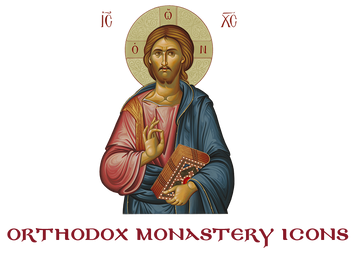
St. Cyriacus, the Hermit of Palestine icon
Orthodox icon of Saint Cyriacus, (Kyriakus, Kyriakos, the Hermit of Palestine.
Commemorated September 29.
Saint Curiacus was born in Corinth in 448. He went to Palestine to the Lavra of Euthymius the Great, but because of his youth was sent by Saint Euthymius to Saint Gerasimus; after the death of Saint Gerasimus he returned to the Lavra of Saint Euthymius. Later he took on a more rigorous life of asceticism in the wilderness of Natoufa, where there was nothing to eat except the exceedingly bitter wild herb called squills, which, however, through his prayers, God made sweet for him and his disciple. He lived 107 years and reposed in the year 555.