Products
St. Lydia icon
Orthodox icon of Saint Lydia of Philippi, the Equal To the Apostles.
Commemorated May 20.
This is an Orthodox icon of St. Lydia of Philippi who was born in Asia Minor in the city of Thiatira in the first century.As recorded in the Acts of the Apostles (16:12-30), Lydia of Philippi was the Apostle Paul's first convert to Christianity in Europe. Her conversion came after hearing Paul's words in Philippi proclaiming the Gospel of Christ during his second missionary journey. Looking for work, she traveled to the city of Philippi in Greek Macedonia.
St. Luke writes that St. Lydia was a porfiropolis, that is a merchant of purple cloth, an expensive type of Roman clothing. She was also a religious woman, showing great respect to the pagan gods. Lydia met with the Apostle Paul on his second missionary journey about the year 50. St. Paul was preaching in the area of Troy when he had a dream. In it, a man told him, Come to Macedonia and help us. St. Paul, along with Silas, traveled to Philippi through Samothrace. At the Gaggitis River, they discovered a crowd praying to the pagan gods. Leading the group in prayer was St. Lydia.
After learning from St. Paul of Our Savior Jesus Christ, St. Lydia was baptized in the Gaggitis River and many idolaters became Christians. Paul and his companions were well received by Lydia as they stayed at her house after their release from the Philippi prison. Surely, during their imprisonment, Lydia and those who assembled in her home spent the night in prayer for the release of Paul and Silas, making her home the first Christian Church in Europe. When Paul departed from Philippi he left Luke behind to preach the Gospel and to establish firmly the church in Philippi, using as its core Lydia, the jailer, and their households.
St. Macarius the Great icon
The Orthodox icon of Saint Macarius, Makarius, Makarios of Egypt, the Great.
Commemorated January 19.
Saint Macarius the Great of Egypt was born in the early fourth century in the village of Ptinapor in Egypt. At the wish of his parents he entered into marriage, but was soon widowed. After he buried his wife, Macarius told himself, “Take heed, Macarius, and have care for your soul. It is fitting that you forsake worldly life.”
The Lord rewarded the saint with a long life, but from that time the memory of death was constantly with him, impelling him to ascetic deeds of prayer and penitence. He began to visit the church of God more frequently and to be more deeply absorbed in Holy Scripture, but he did not leave his aged parents, thus fulfilling the commandment to honor one’s parents.
Until his parents died, Saint Macarius used his remaining substance to help them and he began to pray fervently that the Lord might show him a guide on the way to salvation. The Lord sent him an experienced Elder, who lived in the desert not far from the village. The Elder accepted the youth with love, guided him in the spiritual science of watchfulness, fasting and prayer, and taught him the handicraft of weaving baskets. After building a separate cell not far from his own, the Elder settled his disciple in it.
The local bishop arrived one day at Ptinapor and, knowing of the saint’s virtuous life, ordained him against his will. Saint Macarius was overwhelmed by this disturbance of his silence, and so he went secretly to another place. The Enemy of our salvation began a tenacious struggle with the ascetic, trying to terrify him, shaking his cell and suggesting sinful thoughts. Saint Macarius repelled the attacks of the devil, defending himself with prayer and the Sign of the Cross.
Evil people slandered the saint, accusing him of seducing a woman from a nearby village. They dragged him out of his cell and jeered at him. Saint Macarius endured the temptation with great humility. Without a murmur, he sent the money that he got for his baskets for the support of the pregnant woman.
The innocence of Saint Macarius was manifested when the woman, who suffered torment for many days, was not able to give birth. She confessed that she had slandered the hermit, and revealed the name of the real father. When her parents found out the truth, they were astonished and intended to go to the saint to ask forgiveness. Though Saint Macarius willingly accepted dishonor, he shunned the praise of men. He fled from that place by night and settled on Mt. Nitria in the Pharan desert.
Thus human wickedness contributed to the prospering of the righteous. Having dwelt in the desert for three years, he went to Saint Anthony the Great, the Father of Egyptian monasticism, for he had heard that he was still alive in the world, and he longed to see him. Abba Anthony received him with love, and Macarius became his devoted disciple and follower. Saint Macarius lived with him for a long time and then, on the advice of the saintly abba, he went off to the Skete monastery (in the northwest part of Egypt). He so shone forth in asceticism that he came to be called “a young Elder,” because he had distinguished himself as an experienced and mature monk, even though he was not quite thirty years old.
Saint Macarius survived many demonic attacks against him. Once, he was carrying palm branches for weaving baskets, and a devil met him on the way and wanted to strike him with a sickle, but he was not able to do this. He said, “Macarius, I suffer great anguish from you because I am unable to vanquish you. I do everything that you do. You fast, and I eat nothing at all. You keep vigil, and I never sleep. You surpass me only in one thing: humility.”
When the saint reached the age of forty, he was ordained to the priesthood and made the head of the monks living in the desert of Skete. During these years, Saint Macarius often visited with Saint Anthony the Great, receiving guidance from him in spiritual conversations. Abba Macarius was deemed worthy to be present at the death of Saint Anthony and he received his staff. He also received a double portion of the Anthony’s spiritual power, just as the prophet Elisha once received a double portion of the grace of the prophet Elias, along with the mantle that he dropped from the fiery chariot.
Saint Macarius worked many healings. People thronged to him from various places for help and for advice, asking his holy prayers. All this unsettled the quietude of the saint. He therefore dug out a deep cave under his cell, and hid there for prayer and meditation.
Saint Macarius attained such boldness before God that, through his prayers, the Lord raised the dead. Despite attaining such heights of holiness, he continued to preserve his unusual humility. One time the holy abba caught a thief loadng his things on a donkey standing near the cell. Without revealing that he was the owner of these things, the monk began to help tie up the load. Having removed himself from the world, the monk told himself, “We bring nothing at all into this world; clearly, it is not possible to take anything out from it. Blessed be the Lord for all things!”
Once, Saint Macarius was walking and saw a skull lying upon the ground. He asked, “Who are you?” The skull answered, “I was a chief priest of the pagans. When you, Abba, pray for those in hell, we receive some mitigation.”
The monk asked, “What are these torments?” “We are sitting in a great fire,” replied the skull, “and we do not see one another. When you pray, we begin to see each other somewhat, and this affords us some comfort.” Having heard such words, the saint began to weep and asked, “Are there still more fiercesome torments?” The skull answered, “Down below us are those who knew the Name of God, but spurned Him and did not keep His commandments. They endure even more grievous torments.”
Once, while he was praying, Saint Macarius heard a voice: “Macarius, you have not yet attained such perfection in virtue as two women who live in the city.” The humble ascetic went to the city, found the house where the women lived, and knocked. The women received him with joy, and he said, “I have come from the desert seeking you in order to learn of your good deeds. Tell me about them, and conceal nothing.”
The women answered with surprise, “We live with our husbands, and we have not such virtues.” But the saint continued to insist, and the women then told him, “We married two brothers. After living together in one house for fifteen years, we have not uttered a single malicious nor shameful word, and we never quarrel among ourselves. We asked our husbands to allow us to enter a women’s monastery, but they would not agree. We vowed not to utter a single worldly word until our death.”
Saint Macarius glorified God and said, “In truth, the Lord seeks neither virgins nor married women, and neither monks nor laymen, but values a person’s free intent, accepting it as the deed itself. He grants to everyone’s free will the grace of the Holy Spirit, which operates in an individual and directs the life of all who yearn to be saved.”
During the years of the reign of the Arian emperor Valens (364-378), Saint Macarius the Great and Saint Macarius of Alexandria was subjected to persecution by the followers of the Arian bishop Lucius. They seized both Elders and put them on a ship, sending them to an island where only pagans lived. By the prayers of the saints, the daughter of a pagan priest was delivered from an evil spirit. After this, the pagan priest and all the inhabitants of the island were baptized. When he heard what had happened, the Arian bishop feared an uprising and permitted the Elders to return to their monasteries.
The meekness and humility of the monk transformed human souls. “A harmful word,” said Abba Macarius, “makes good things bad, but a good word makes bad things good.” When the monks asked him how to pray properly, he answered, “Prayer does not require many words. It is needful to say only, “Lord, as Thou wilt and as Thou knowest, have mercy on me.” If an enemy should fall upon you, you need only say, “Lord, have mercy!” The Lord knows that which is useful for us, and grants us mercy.”
When the brethren asked how a monk ought to comport himself, the saint replied, “Forgive me, I am not yet a monk, but I have seen monks. I asked them what I must do to be a monk. They answered, ‘If a man does not withdraw himself from everything which is in the world, it is not possible to be a monk.’ Then I said, ‘I am weak and cannot be as you are.’ The monks responded, ‘If you cannot renounce the world as we have, then go to your cell and weep for your sins.’”
Saint Macarius gave advice to a young man who wished to become a monk: “Flee from people and you shall be saved.” That one asked: “What does it mean to flee from people?” The monk answered: “Sit in your cell and repent of your sins.”
Saint Macarius sent him to a cemetery to rebuke and then to praise the dead. Then he asked him what they said to him. The young man replied, “They were silent to both praise and reproach.” “If you wish to be saved, be as one dead. Do not become angry when insulted, nor puffed up when praised.” And further: “If slander is like praise for you, poverty like riches, insufficiency like abundance, then you shall not perish.”
The prayer of Saint Macarius saved many in perilous circumstances of life, and preserved them from harm and temptation. His benevolence was so great that they said of him: “Just as God sees the whole world, but does not chastize sinners, so also does Abba Macarius cover his neighbor’s weaknesses, which he seemed to see without seeing, and heard without hearing.”
The monk lived until the age of ninety. Shortly before his death, Saints Anthony and Pachomius appeared to him, bringing the joyful message of his departure to eternal life in nine days. After instructing his disciples to preserve the monastic Rule and the traditions of the Fathers, he blessed them and began to prepare for death. Saint Macarius departed to the Lord saying, “Into Thy hands, O Lord, I commend my spirit.”
Abba Macarius spent sixty years in the wilderness, being dead to the world. He spent most of his time in conversation with God, often in a state of spiritual rapture. But he never ceased to weep, to repent and to work. The saint’s profound theological writings are based on his own personal experience. Fifty Spiritual Homilies and seven Ascetic Treatises survive as the precious legacy of his spiritual wisdom. Several prayers composed by Saint Macarius the Great are still used by the Church in the Prayers Before Sleep and also in the Morning Prayers.
Man’s highest goal and purpose, the union of the soul with God, is a primary principle in the works of Saint Macarius. Describing the methods for attaining mystical communion, the saint relies upon the experience of the great teachers of Egyptian monasticism and on his own experience. The way to God and the experience of the holy ascetics of union with God is revealed to each believer’s heart.
Earthly life, according to Saint Macarius, has only a relative significance: to prepare the soul, to make it capable of perceiving the heavenly Kingdom, and to establish in the soul an affinity with the heavenly homeland.
“For those truly believing in Christ, it is necessary to change and transform the soul from its present degraded nature into another, divine nature, and to be fashioned anew by the power of the Holy Spirit.”
This is possible, if we truly believe and we truly love God and have observed all His holy commandments. If one betrothed to Christ at Baptism does not seek and receive the divine light of the Holy Spirit in the present life, “then when he departs from the body, he is separated into the regions of darkness on the left side. He does not enter into the Kingdom of Heaven, but has his end in hell with the devil and his angels” (Homily 30:6).
In the teaching of Saint Macarius, the inner action of the Christian determines the extent of his perception of divine truth and love. Each of us acquires salvation through grace and the divine gift of the Holy Spirit, but to attain a perfect measure of virtue, which is necessary for the soul’s assimilation of this divine gift, is possible only “by faith and by love with the strengthening of free will.” Thus, the Christian inherits eternal life “as much by grace, as by truth.”
Salvation is a divine-human action, and we attain complete spiritual success “not only by divine power and grace, but also by the accomplishing of the proper labors.” On the other hand, it is not just within “the measure of freedom and purity” that we arrive at the proper solicitude, it is not without “the cooperation of the hand of God above.” The participation of man determines the actual condition of his soul, thus inclining him to good or evil. “If a soul still in the world does not possess in itself the sanctity of the Spirit for great faith and for prayer, and does not strive for the oneness of divine communion, then it is unfit for the heavenly kingdom.”
The miracles and visions of Blessed Macarius are recorded in a book by the presbyter Rufinus, and his Life was compiled by Saint Serapion, bishop of Tmuntis (Lower Egypt), one of the renowned workers of the Church in the fourth century. His holy relics are in the city of Amalfi, Italy.
Reference: O.C.A.
St. Macrina Icon
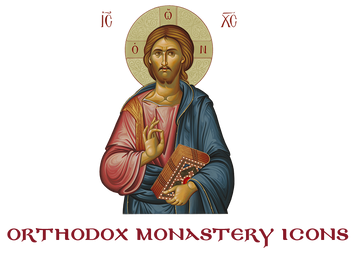
Orthodox icon of Saint Macrina, Makrina.
Commemorated July 19th.
Protector Saint of : Siblings
Saint Macrina was the sister of the holy hierarchs Basil the Great and Gregory of Nyssa. When all the children grew up and left the parental home, St Macrina convinced her mother, St Emilia, to enter a women's monastery. After the death of her mother, St Macrina guided the sisters of the monastery.
St Macrina was granted the gift of wonderworking. St Macrina died in the year 380. Saint Gregory of Nyssa wrote a "Dialogue on the Soul and Resurrection" to commemorate Macrina, in which he describes the conversation he had with Macrina on her deathbed.
St. Mamas, protector of animals icon
Orthodox icon of Saint Mamas.
Protector Saint of : Adopted Children and their parents, Animals.
Commemorated September 2.
The Holy Great Martyr Mamas was born in Paphlagonia, Asia Minor in the third century of pious and illustrious parents, the Christians Theodotus and Rufina. The parents of the saint were arrested by the pagans for their open confession of their faith and locked up in prison in Caesarea in Cappadocia. Mamass was tortured for his faith by the governor of Caesarea and was then sent before the Roman Emperor Aurelian, who tortured him again.
The Mammes legend states that an angel then liberated him and ordered him to hide himself on a mountain near Caesarea.Mamams was later thrown to the lions, but managed to make the beasts docile. He preached to animals in the fields, and a lion remained with him as companion. Accompanied by the lion, he visited Duke Alexander, who condemned him to death. He was struck in the stomach with a trident. Bleeding, Mammes dragged himself to a spot near a theater before his soul was carried into heaven by angels.
St Basil the Great speaks thus about the holy Martyr Mamas in a sermon to the people: Remember the holy martyr, you who live here and have him as a helper. You who call on his name have been helped by him. Those in error he has guided into life. Those whom he has healed of infirmity, those whose children were dead he has restored to life, those whose life he has prolonged: let us all come together as one, and praise the martyr!
Customer Reviews
St. Margaret icon
Orthodox icon of Saint Margaret or Margarita.
Commemorated September 1st.
St. Marianthe icon
Orthodox icon of Saint Marianthe.
Commemorated September 1.
St. Marina the Great Martyr icon (1)
Orthodox icon of Holy Great Martyr Marina.
Commemorated July 17.
The Holy Great Martyr Marina was born in Asia Minor, in the city of Antioch of Pisidia (southern Asia Minor), into the family of a pagan priest. In infancy she lost her mother, and her father gave her into the care of a nursemaid, who raised Marina in the Orthodox Faith. Upon learning that his daughter had become a Christian, the father angrily disowned her. During the time of the persecution against Christians under the emperor Diocletian (284-305), when she was fifteen years old, St Marina was arrested and locked up in prison.
With firm trust in the will of God and His help, the young prisoner prepared for her impending fate. The governor Olymbrios, charmed with the beautiful girl, tried to persuade her to renounce the Christian Faith and become his wife. But the saint, unswayed, refused his offers. The vexed governor gave the holy martyr over to torture. Having beaten her fiercely, they fastened the saint with nails to a board and tore at her body with tridents.
The governor himself, unable to bear the horror of these tortures, hid his face in his hands. But the holy martyr remained unyielding. Thrown for the night into prison, she was granted heavenly aid and healed of her wounds. They stripped her and tied her to a tree, then burned the martyr with fire. Barely alive, the martyr prayed: Lord, You have granted me to go through fire for Your Name, grant me also to go through the water of holy Baptism. Hearing the word water, the governor gave orders to drown the saint in a large cauldron.
The martyr besought the Lord that this manner of execution should become for her holy Baptism. When they plunged her into the water, there suddenly shone a light, and a snow-white dove came down from Heaven, bearing in its beak a golden crown. The fetters put upon St Marina came apart by themselves. The martyr stood up in the fount of Baptism glorifying the Holy Trinity, Father, Son, and Holy Spirit. St Marina emerged from the fount completely healed, without any trace of burns.
Amazed at this miracle, the people glorified the True God, and many came to believe. This brought the governor into a rage, and he gave orders to kill anyone who might confess the Name of Christ. 15,000 Christians perished there, and the holy Martyr Marina was beheaded. The sufferings of the Great Martyr Marina were described by an eyewitness of the event, named Theotimos. Up until the taking of Constantinople by Western crusaders in the year 1204, the relics of the Great Martyr Marina were in the Panteponteia monastery.
According to other sources, they were located in Antioch until the year 908 and from there transferred to Italy. Now they are in Athens, in a church dedicated to the holy Virgin Martyr. Her venerable hand was transferred to Mount Athos, to the Batopedi monastery.
Reference: O.C.A.
St. Marina the Great Martyr icon (2)
Orthodox icon of Saint Marina (2). Icon of 13th cent. Byzantine Museus of Athens.
Commemorated July 17th.
St. Marina the Great Martyr icon (3)
Orthodox icon of Holy Great Martyr Marina (3).
Commemorated July 17.
The Holy Great Martyr Marina was born in Asia Minor, in the city of Antioch of Pisidia (southern Asia Minor), into the family of a pagan priest. In infancy she lost her mother, and her father gave her into the care of a nursemaid, who raised Marina in the Orthodox Faith. Upon learning that his daughter had become a Christian, the father angrily disowned her. During the time of the persecution against Christians under the emperor Diocletian (284-305), when she was fifteen years old, St Marina was arrested and locked up in prison.
With firm trust in the will of God and His help, the young prisoner prepared for her impending fate. The governor Olymbrios, charmed with the beautiful girl, tried to persuade her to renounce the Christian Faith and become his wife. But the saint, unswayed, refused his offers. The vexed governor gave the holy martyr over to torture. Having beaten her fiercely, they fastened the saint with nails to a board and tore at her body with tridents.
The governor himself, unable to bear the horror of these tortures, hid his face in his hands. But the holy martyr remained unyielding. Thrown for the night into prison, she was granted heavenly aid and healed of her wounds. They stripped her and tied her to a tree, then burned the martyr with fire. Barely alive, the martyr prayed: Lord, You have granted me to go through fire for Your Name, grant me also to go through the water of holy Baptism. Hearing the word water, the governor gave orders to drown the saint in a large cauldron.
The martyr besought the Lord that this manner of execution should become for her holy Baptism. When they plunged her into the water, there suddenly shone a light, and a snow-white dove came down from Heaven, bearing in its beak a golden crown. The fetters put upon St Marina came apart by themselves. The martyr stood up in the fount of Baptism glorifying the Holy Trinity, Father, Son, and Holy Spirit. St Marina emerged from the fount completely healed, without any trace of burns.
Amazed at this miracle, the people glorified the True God, and many came to believe. This brought the governor into a rage, and he gave orders to kill anyone who might confess the Name of Christ. 15,000 Christians perished there, and the holy Martyr Marina was beheaded. The sufferings of the Great Martyr Marina were described by an eyewitness of the event, named Theotimos. Up until the taking of Constantinople by Western crusaders in the year 1204, the relics of the Great Martyr Marina were in the Panteponteia monastery.
According to other sources, they were located in Antioch until the year 908 and from there transferred to Italy. Now they are in Athens, in a church dedicated to the holy Virgin Martyr. Her venerable hand was transferred to Mount Athos, to the Batopedi monastery.
Reference: O.C.A.
St. Mark Bishop of Ephesus icon
Orthodox icon of Saint Mark, Bishop of Ephesus.
Commemorated January 19.
The great teacher and invincible defender of the One, Holy, Catholic, and Apostolic Church, Saint Mark, was the offspring and scion of the imperial city, Constantinople. Reared by most pious parents, and instructed in secular and spiritual wisdom, he became preeminent in both. In 1418, at the age of 26, Manuil left the capital and went to Antigone, an island then governed by Byzantium located at the mouth of the gulf of Nicomedia.
Abbot Simeon became the Saintu2019s spiritual father, and tonsured him into monasticism, with the name Mark.u00a0Saint Mark lived as an ascetic on the Prince's Islands and later in the monastery of Saint George Magana in Constantinople. He passed through all the degrees of the priesthood, and was finally advanced to the dignity of Archbishop and the lofty throne of the Metropolis of Ephesus in 1437.
At the insistence of Emperor John Paleologos, the Saint was sent to the council of the Latins in Florence, to unite the churches that had been divided for so many years over the following issues:1) the issue of the Procession of the Holy Spirit; 2) the issue of the use of azymes, unleavened bread, for the Eucharist in the Roman Catholic Church; 3) the teachings with respect to Purgatory; and 4) the primacy of the Pope of Rome - issues that till separate the churches.
By the final session the Orthodox Greeks found themselves in a difficult position: exhausted, suffering from privations, submitted to a variety of restrictions, lacking the resources to return to their homeland, and recognizing Byzantium's truly sorry state. In effect, they were invited to sell out the Orthodox Church in return for generous assistance both to the state and to the Greek delegates to the Council Saint Mark was the only one who did not sign the blasphemous decree of that false council. He returned to his see in Ephesus and continued to campaign against the compromises of this council in the name of unity.
The Saint was arrested on the island of Limnos, and was incarcerated for two years, during which he suffered from sickness, a severe climate, and deprivation of many of the essentials of life. Because of His defense of the Truth of Orthodoxy, the Holy Church of Christ has ever honored this great man as a benefactor, teacher, sole defender, and invincible champion of the Apostolic Confession. He is known along withSt. Photius the Great and St. Gregory Palamas, as a Pillar of Orthodoxy.
He reposed in 1443.
Reference: O.C.A.
St. Mark the Apostle and Evangelist icon
Orthodox icon of Saint Mark the Evangelist and Apostle.
Commemorated April 25.
Holy Apostle and Evangelist Mark was one of the Seventy Apostles, and a nephew of St Barnabas (June 11). He was born at Jerusalem. The house of his mother Mary adjoined the Garden of Gethsemane. As Church Tradition relates, on the night that Christ was betrayed he followed after Him, wrapped only in a linen cloth. He was seized by soldiers, and fled away naked, leaving the cloth behind (Mark 14:51-52).
After the Ascension of the Lord, the house of his mother Mary became a place where Christians gathered, and a place of lodging for some of the Apostles (Acts 12:12). St Mark was a very close companion of the Apostles Peter and Paul and Barnabas. St Mark was at Seleucia with Paul and Barnabas, and from there he set off to the island of Cyprus, and he traversed the whole of it from east to west. After working with the Apostle Paul, St Mark returned to Jerusalem, and then went to Rome with the Apostle Peter.
From there, he set out for Egypt, where he established a local Church. St Mark met St Paul in Antioch. From there he went with St Barnabas to Cyprus, and then he went to Egypt again, where he and St Peter founded many churches. Then he went to Babylon. From this city the Apostle Peter sent an Epistle to the Christians of Asia Minor, in which he calls St Mark his son (1 Pet 5:13). When the Apostle Paul came to Rome in chains, St Mark was at Ephesus, where St Timothy was bishop. St Mark went with him to Rome. There he also wrote his holy Gospel (ca. 62-63). From Rome St Mark traveled to Egypt.
In Alexandria he started a Christian school, which later produced such famous Fathers and teachers of the Church as Clement of Alexandria, St Dionysius of Alexandria, St Gregory Thaumatourgos, and others. Zealous for Church services, St Mark composed a Liturgy for the Christians of Alexandria. St Mark preached the Gospel in the inner regions of Africa, and he was in Libya at Nektopolis. During these journeys, St Mark was inspired by the Holy Spirit to go again to Alexandria and confront the pagans.
There he visited the home of Ananias, and healed his crippled hand. The dignitary happily took him in, listened to his words, and received Baptism. Following the example of Ananias, many of the inhabitants of that part of the city where he lived were also baptized. This roused the enmity of the pagans, and they wanted to kill St Mark. Having learned of this, St Mark made Ananias a bishop, and the three Christians Malchos, Sabinos, and Kerdinos were ordained presbyters to provide the church with leadership after his death.
The pagans seized St Mark when he was serving the Liturgy. They beat him, dragged him through the streets and threw him in prison. There St Mark was granted a vision of the Lord Jesus Christ, Who strengthened him before his sufferings. On the following day, the angry crowd again dragged the saint through the streets to the courtroom, but along the way St Mark died saying, Into Your hands, O Lord, I commend my spirit.The pagans wanted to burn the saint's body, but when they lit the fire, everything grew dark, thunder crashed, and there was an earthquake. The pagans fled in terror, and Christians took up the body of St Mark and buried it in a stone crypt. This was on April 4, 63.
The Church celebrates his memory on April 25. In the year 310, a church was built over the relics of St Mark. In 820, when the Moslem Arabs had established their rule in Egypt and oppressed the Christian Church, the relics of St Mark were transferred to Venice and placed in the church named for him. In the ancient iconographic tradition, which adopted symbols for the holy Evangelists borrowed from the vision of St John the Theologian (Rev 4:7) and the prophecy of Ezekiel (Ez. 1:10), the holy Evangelist Mark is represented by a lion, symbolizing the might and royal dignity of Christ (Rev 5:5). St Mark wrote his Gospel for Gentile Christians, emphasizing the words and deeds of the Savior which reveal His divine Power.
Many aspects of his account can be explained by his closeness to St Peter. The ancient writers say that the Gospel of Mark is a concise record of St Peteru2019s preaching. One of the central theological themes in the Gospel of St Mark is the power of God achieving what is humanly impossible. The Apostles performed remarkable miracles with Christ (Mark 16:20) and the Holy Spirit (Mark 13:11) working through them.
His disciples were told to go into the world and preach the Gospel to all creatures (Mark 13:10, 16:15), and that is what they did.
Reference: O.C.A.
Customer Reviews
St. Mark the Apostle and Evangelist icon (2)
Orthodox icon of Saint Mark the Apostle and Evangelist (2). Icon of 14 cent. Chilandari Monastery Mount Athos.
Commemorated March 25t
St. Mark the Apostle and Evangelist icon (3)
Orthodox icon of Saint Mark the Evangelist and Apostle (3). Copy of an icon of 16 cent. Kremlin Museum
Commemorated April 25.
Holy Apostle and Evangelist Mark was one of the Seventy Apostles, and a nephew of St Barnabas (June 11). He was born at Jerusalem. The house of his mother Mary adjoined the Garden of Gethsemane. As Church Tradition relates, on the night that Christ was betrayed he followed after Him, wrapped only in a linen cloth. He was seized by soldiers, and fled away naked, leaving the cloth behind (Mark 14:51-52).
After the Ascension of the Lord, the house of his mother Mary became a place where Christians gathered, and a place of lodging for some of the Apostles (Acts 12:12). St Mark was a very close companion of the Apostles Peter and Paul and Barnabas. St Mark was at Seleucia with Paul and Barnabas, and from there he set off to the island of Cyprus, and he traversed the whole of it from east to west. After working with the Apostle Paul, St Mark returned to Jerusalem, and then went to Rome with the Apostle Peter.
From there, he set out for Egypt, where he established a local Church. St Mark met St Paul in Antioch. From there he went with St Barnabas to Cyprus, and then he went to Egypt again, where he and St Peter founded many churches. Then he went to Babylon. From this city the Apostle Peter sent an Epistle to the Christians of Asia Minor, in which he calls St Mark his son (1 Pet 5:13). When the Apostle Paul came to Rome in chains, St Mark was at Ephesus, where St Timothy was bishop. St Mark went with him to Rome. There he also wrote his holy Gospel (ca. 62-63). From Rome St Mark traveled to Egypt.
In Alexandria he started a Christian school, which later produced such famous Fathers and teachers of the Church as Clement of Alexandria, St Dionysius of Alexandria, St Gregory Thaumatourgos, and others. Zealous for Church services, St Mark composed a Liturgy for the Christians of Alexandria. St Mark preached the Gospel in the inner regions of Africa, and he was in Libya at Nektopolis. During these journeys, St Mark was inspired by the Holy Spirit to go again to Alexandria and confront the pagans.
There he visited the home of Ananias, and healed his crippled hand. The dignitary happily took him in, listened to his words, and received Baptism. Following the example of Ananias, many of the inhabitants of that part of the city where he lived were also baptized. This roused the enmity of the pagans, and they wanted to kill St Mark. Having learned of this, St Mark made Ananias a bishop, and the three Christians Malchos, Sabinos, and Kerdinos were ordained presbyters to provide the church with leadership after his death.
The pagans seized St Mark when he was serving the Liturgy. They beat him, dragged him through the streets and threw him in prison. There St Mark was granted a vision of the Lord Jesus Christ, Who strengthened him before his sufferings. On the following day, the angry crowd again dragged the saint through the streets to the courtroom, but along the way St Mark died saying, Into Your hands, O Lord, I commend my spirit.The pagans wanted to burn the saint's body, but when they lit the fire, everything grew dark, thunder crashed, and there was an earthquake. The pagans fled in terror, and Christians took up the body of St Mark and buried it in a stone crypt. This was on April 4, 63.
The Church celebrates his memory on April 25. In the year 310, a church was built over the relics of St Mark. In 820, when the Moslem Arabs had established their rule in Egypt and oppressed the Christian Church, the relics of St Mark were transferred to Venice and placed in the church named for him. In the ancient iconographic tradition, which adopted symbols for the holy Evangelists borrowed from the vision of St John the Theologian (Rev 4:7) and the prophecy of Ezekiel (Ez. 1:10), the holy Evangelist Mark is represented by a lion, symbolizing the might and royal dignity of Christ (Rev 5:5). St Mark wrote his Gospel for Gentile Christians, emphasizing the words and deeds of the Savior which reveal His divine Power.
Many aspects of his account can be explained by his closeness to St Peter. The ancient writers say that the Gospel of Mark is a concise record of St Peteru2019s preaching. One of the central theological themes in the Gospel of St Mark is the power of God achieving what is humanly impossible. The Apostles performed remarkable miracles with Christ (Mark 16:20) and the Holy Spirit (Mark 13:11) working through them.
His disciples were told to go into the world and preach the Gospel to all creatures (Mark 13:10, 16:15), and that is what they did.
Reference: O.C.A.
St. Markella icon
Orthodox icon of Saint Markella of Chios.
Commemorated July 22.
Saint Markella lived in the village of Volissos, Chios sometime after the middle of the fourteenth century. Her parents were Christians, and among the wealthiest citizens of Volissos. The saint's mother died when she was young, and so her father, the mayor of the village, saw to her upbringing. He was a difficult man who was cynical about the Church. Markella had been taught by her pious mother to be respectful and devout, and to guard her purity.
She avoided associations with other girls who were more outgoing than she was so that she would not come to spiritual harm through such company. Her goal was to attain the Kingdom of Heaven, and to become a bride of Christ. St Markella increased in virtue as she grew older, fasting, praying, and attending church services, aiding the poor and always trying to being others to the way of God.
She loved and respected her father, and comforted him in his sorrow. She told him she would take care of him in his old age, and would not abandon him. As an adult, Staint Markella was loved by everyone for her beauty and for her spiritual gifts. The Enemy of our salvation incited her father with an unnatural desire for his daughter. The unfortunate man spent a long time struggling against his lust, but, finally, he gave in to it. At times he would speak to his daughter roughly, then later he would appear to be gentle.
He no longer looked at Markella as his daughter but as a woman lustfully. He wanted to be near her, and to stroke her hair. Eventually Markella understood her fathers intentions. Horrified, the saint prayed to the Panagia for protection and tried to avoid him as much as she could. One morning she decided to leave her father's house. She ran away to the mountains. He father saw her leaving and began to chase her. But he could not keep up with her due to his old age. He yelled to her that he would find her and tear her apart.
Markella made it to the mountain top and hid in some bushes. Fearing her death she asked God to give her strength enabling her to overcome this evil. She remained there until nightfall awaiting her fathers arrival. It was a night with a full moon that lit up the countryside. She heard bells of a flock of sheep and a shepherdess appeared and she called out to her. Markella told her she was fleeing evil but did not tell her the details. Markella was well loved throughout the community. Marouso, the shepherdess volunteered to stay and be watchful.
They took turns while one slept the other stood watch.The people in her village Volissos noticed her absence and sought to find out where she was from her father. He told then sarcastically that she went to become a saint. Rage built up in her father and he took a knife and his bow and arrow and sought out after her. Markella and her friend saw him coming and she went into a nearby cave to hide. Her father encountered the shepherdess who told him nothing about her hiding place. He passed by and Marouso went to the cave where Makella was hiding and told her where her father had headed.
Markella then decided to leave this place and headed south towards the beach when she saw a shepherd. She approached near him and hid in a huge bush disregarding its thorns. The shepherd came over to see who this was and was surprised to find out it was Markella. The shepherd heard the approach of a horse and immediately her father was in front of him. With fiery eyes and foaming in the mouth he asked if he had seen Markella. Her father drew his knife as to threaten him so as he would tell him her location
. Frightened the shepherd pointed to the bush where Markella was hiding. Markella continued to pray as he approached her hiding place. He set the bush on fire to drive her out. Markella ran out the other side and ran toward the jagged rocks along the shoreline. She screamed for Christ and the Panagia to help her. She was bleeding from the thorns and ran frantically. Then she felt a pain in her thigh. She stopped and pulled out an arrow that her father had shot at her. It bled profusely. Meanwhile her father was getting closer Suddenly she was filled with the Holy Spirit. He countenance was filled with light. She was ready to fulfill a martyrs death. She continued to run along the rocky shoreline calling on the Panagia as she ran.
Exhausted she fell to her knees and miraculously the rock on which she stood gave way and split open and received her body up to the waist. Her father was viscously joyful that he had now captured her. He took out his knife and he cut off her breasts. Her blood spayed in all directions covering him with her blood. Markella again prayed to Christ and the Panagia. u00a0He then cut off her head and cast it into the sea. The sea crashed on the rocks and her father was fearful that he would be taken into the sea punishing him for his horrible crime.
So he ran to escape the scene of his crime. In later years, pious Christians built a church on the spot where St Markella hid in the bush. The spot where she was killed became known as The Martyrdom of St Markella, and the rock that opened to receive her is still there. The rock appears to be a large stone that broke off from a mountain and rolled into the sea. Soil from the mountain covers the spot on the side facing the land.
On the side facing the ocean is a small hole, about the size of a finger. A healing water flows from the opening, which cures every illness. The flow of water is not due to the movements of the tide, because when the tide is out, there would be no water. This, however, is not the case. The water is clear, but some of the nearby rocks have been stained with a reddish-yellow color. According to tradition, the lower extremities of St Markella's body are concealed in the rock. The most astonishing thing about the rock is not the warmth of the water, nor the discoloration of the other rocks, but what happens when a priest performs the Blessing of Water.
A sort of steam rises up from the water near the rock, and the entire area is covered with a mist. The sea returns to normal as soon as the service is over. Many miracles have occurred at the spot, and pilgrims flock there from all over the world.
Reference: G.O.A.A.